
Brain Breaks for Students: Elementary & Middle School
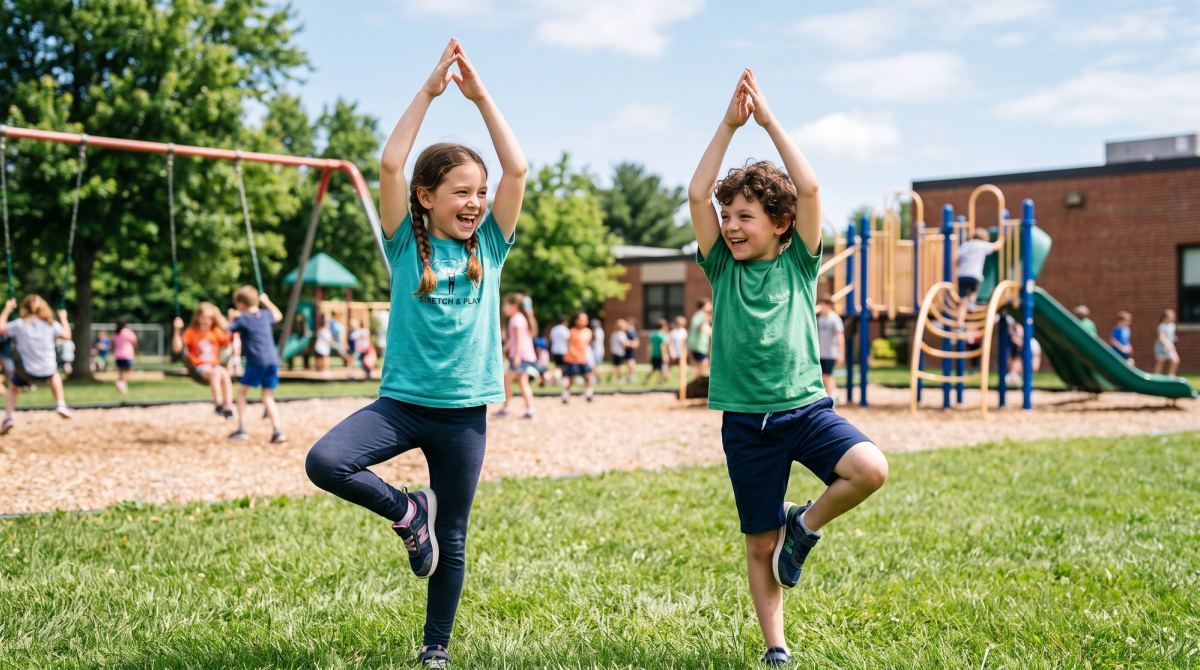

Twenty minutes into a lesson, the room changes. Pencils start tapping. Eyes drift to the window. And whatever you say next isn't really landing.
Brain breaks for students are how you get them back. A brain break is a short movement pause that resets attention between tasks — to discharge restless energy or pull a drifting mind back in a minute or two.
They work at every age. What changes is how you run one: a seven-year-old will happily gallop like a horse; a fifteen-year-old will not. Get the format right for the age, and the same simple idea carries from a first-grade carpet to a middle-school desk — at school and at home.
Brain breaks for students are short movement resets (usually 5 to 10 minutes) that help elementary and middle schoolers release energy, settle, and refocus between tasks. The moves stay the same across ages; older students just need quicker, more discreet, or challenge-based versions.
Key takeaways
- A brain break is a short reset to refocus a student's attention — not a reward for good behavior.
- The move scales with the age: an animal walk for a seven-year-old becomes a desk-side challenge for a thirteen-year-old.
- Older kids reset best when the break is quick, discreet, or competitive — anything that doesn't feel babyish.
If the idea is new to you, our guide to brain breaks for kids covers the basics and a starter set for younger children. Here, we focus on what changes as kids get older.
Brain breaks for elementary students (grades K–5)
By the early school years, a brain break can carry a bit more structure — and a bit more challenge than the story-wrapped moves that work for preschoolers. Elementary students can follow a two-step sequence, race the clock, and take turns leading, which makes the reset feel like their idea instead of yours.
The reset itself still happens through the body. When a child crosses the midline (right hand to left knee, then left hand to right knee) or gets their heart rate up for sixty seconds, they re-engage the thinking brain through the body.
That's the brain-body connection we build everything around, and it isn't a hunch: a review of experimental studies found that aerobic movement at a moderate-to-vigorous intensity promotes children's goal-directed attention and self-control. We unpack the mechanism in our guide to brain activation exercises for kids.
A few elementary brain breaks that earn their 5 minutes:
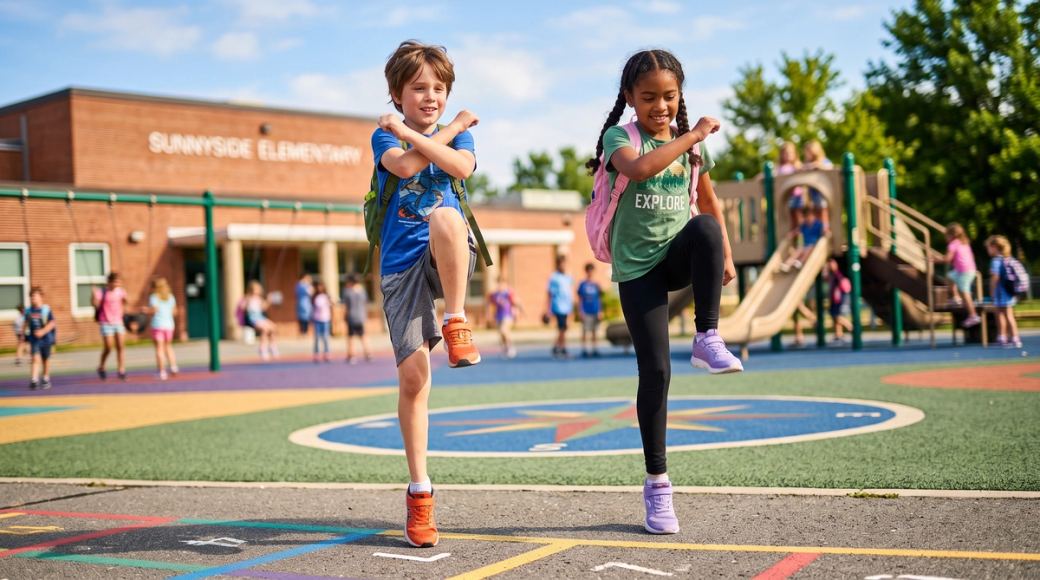
- Cross-crawl count. March in place touching opposite hand to knee, and count to twenty together — then try to beat it, faster and cleaner. The cross-body pattern is the point.
- Animal relays. Bear-crawl to the wall and crab-walk back. Big-muscle movement burns off the fidget that's really a brain asking for input.
- Beat-your-score balance. One foot, arms out, count the seconds — then swap feet and try to top it. A focus target and a body challenge in one.
For a class of eight- or nine-year-olds mid-afternoon, these double as 3rd grade brain breaks: short enough to slot between subjects, structured enough that nobody spins out.
Brain breaks for middle school
Somewhere around middle school, the freeze dance stops working. A twelve-year-old knows exactly how it looks to hop like a bunny in front of their classmates, and they'll opt out rather than risk it. That isn't resistance to the reset — it's resistance to feeling babyish.
Brain breaks for middle school work best when they're competitive, discreet, or purposeful — something a teen can do without feeling watched:
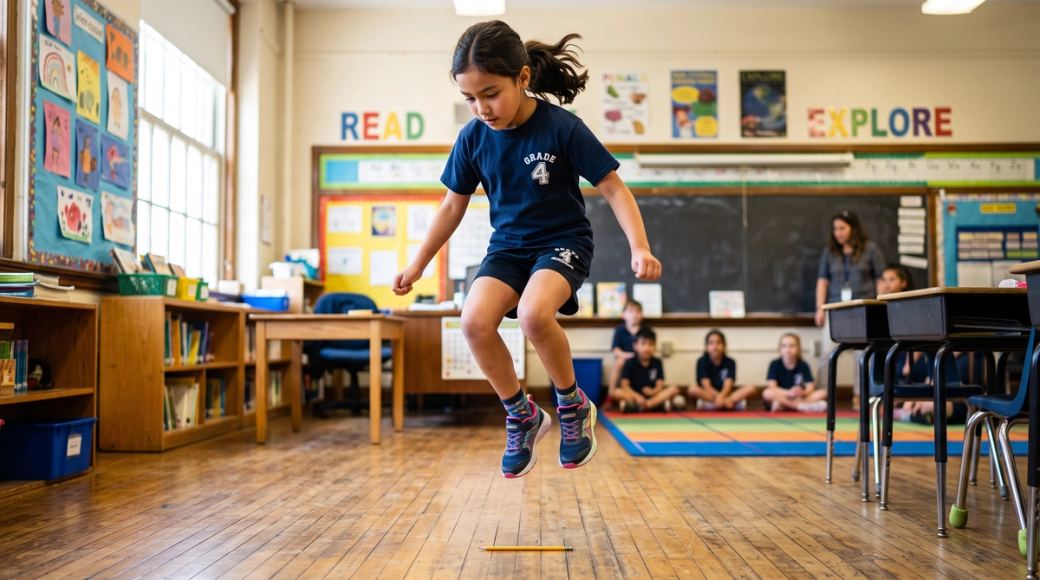
- Sit-to-stand challenge. How many times can you stand fully from your chair and sit back down in thirty seconds? Everyone counts their own. It's a squat by another name, and the number gives them something to beat.
- Desk push-ups. Hands on the desk edge, a set of ten. Quiet, contained, and it gets blood moving without anyone having to perform.
- Four corners. Number the corners of the room and call out a sequence to move through. Make the sequence longer each round, and it becomes a memory challenge, not a game.
- Partner mirror. In pairs, one leads a slow movement and the other mirrors it, then they switch. The focus it takes to track a partner is the reset.
The rule for this age: give them a number to chase or a partner to work with, and the self-consciousness melts.

Not sure which version fits your child?
Brain breaks for high school students
By high school, the ask changes again. Teens are carrying real cognitive load, and what they need is less "shake out the wiggles" and more "clear the buffer before the next thing." Framed as a performance reset rather than a break, older students will actually do it.
Brain breaks for high school students lean discreet and self-directed:
- The discreet desk reset. A slow seated spinal twist each way, a few shoulder rolls, one long exhale.
- Box breathing before a test. In for four, hold for four, out for four, hold for four — two or three rounds. It steadies a racing body before a high-stakes moment, which is a skill worth having well past school.
- Timed hold. For a class that wants to compete, a wall-sit or plank against the clock gives them an outlet and a number, and it's over in under a minute.
Hand them the reset as a tool they control, not a routine imposed on them.
A brain break and free time are not the same thing. In the classroom, a brain break should have a clear purpose, a defined duration, and a planned return to learning. As children grow older, the challenge is also to make these activities meaningful enough that students understand their value rather than perceive them as childish. When students understand why they are resetting, the break can gradually become a tool they learn to use for themselves.

How to run one without losing the room
A brain break only helps if children come back afterward — otherwise, you've traded a slump for chaos. A few things make that reliable:
- Use a consistent signal. The same chime, hand-raise, or count-in every time. That predictability is what lets a wound-up room settle on cue.
- Time-box it out loud. "One minute, then we're back." Name the end before you start, so coming back isn't a negotiation.
- Match the break to the moment. Restless and wound-up? Go active to burn it off. Scattered after a test? A slow, focusing reset lands better than a high-energy one.
The part that matters most isn't any single break — it's the rhythm. Consistency beats intensity here: a one-minute reset you run every day does more than an elaborate "focus activity" you try once and abandon. And on-task behavior is exactly what the evidence points to — a systematic review of active breaks in students aged 5 to 18 found that short movement breaks, especially at a moderate-to-vigorous intensity, were linked to better on-task behavior in class.
These work in the classroom — and the same movement-based approach is what we build into a personalized at-home plan a parent can run with a child. Our Brain Activation Plan for Kids matches short daily movement practices to a child's age and to whatever's hardest right now — the restlessness, the drifting focus.

Start with one small step
Making brain breaks work in real classrooms
In practice, two things get in the way most often: limited classroom space and different teachers sharing the same class.
When the room is too small for movement. Relays and four corners assume floor space most classrooms don't have. Swap the activity, not the break — seated twists, sit-to-stand, in-place cross-crawls, and box breathing deliver the same reset from beside the desk.
When the class sees several teachers a day. A consistent routine in one lesson is enough to help attention rebound. Where a grade team wants to align, agree on three things: one signal students recognize across rooms, a fixed 2–3 minute window, and a short menu of activities every teacher is comfortable leading. That way it stops feeling like one teacher's quirk.
The activity changes with the classroom, but the intent doesn't.
Signs it's time to ask for support
Brain breaks are a daily tool, not a diagnosis and not a fix for everything. Most restlessness, drifting, or fidgeting at any age is a normal brain doing a normal thing — asking for a reset. But if a child seems consistently unable to settle or focus even with support, across settings and over weeks, that's worth a conversation with a pediatrician or the school's learning team — not something a two-minute movement break is meant to carry on its own. Trust what you're seeing over time, and ask.
Frequently asked questions
What are brain breaks for elementary students?
What are brain breaks for middle school?
What are good brain breaks for high school students?
Where to start, whatever the grade
Every class hits a wall. The fourth-graders lose focus after lunch. The middle-schoolers drift in third period. The teens fade before the bell. The moment looks different at every age, but the need for a reset stays the same.
Brain breaks for students work best when you pick the right move for their age and repeat it often. So pick one to start with. Little ones can do an animal walk. Tweens can race a sit-to-stand challenge. Teens can do a quiet desk reset.
Keep it small and regular. Soon it becomes something they reach for on their own, and that's the whole point.
Related articles

Calming Brain Breaks: Quiet Activities to Settle Kids Down
Calming brain breaks: quiet, breath-and-balance activities that settle a wound-up child, including rainbow breathing, for home or the classroom.
Movement Breaks: Get Kids Moving to Reset Focus
Movement breaks reset a child's focus by working the body first. Here's the science, when to use them, and movement break ideas for class or home.

Easy Brain Breaks for the Classroom
Brain breaks for the classroom: an evidence-informed teacher's guide to quick movement resets that refocus a class — by grade, energy level, and transition.

Brain Breaks for Kindergarten and Preschool (Ages 3–6)
Brain breaks for kindergarten and preschool: short, playful movement pauses for ages 3–6 that reset wiggly focus at circle time or at home.