
How to Help Your Child Focus Longer


You're in the parent-teacher conference, and the teacher says it gently: "he's so smart — he just can't sit still." You're at the homework table, and the same child who explained the plot of an entire chapter book yesterday can't get through three math problems today. You're at the front door at 8:14 a.m., and the kid who can recite every planet by heart has forgotten his lunchbox again.
If any of that sounds familiar, your child isn't lazy, and they're not careless. Bright minds often develop faster than self-control — the thinking part of the brain matures earlier than the brake. What looks like won't is, very often, can't yet.
How to help your child focus is partly a question about what's happening inside the brain, and partly a question about what kind of daily input actually moves the dial. This guide covers both and gives you something you can start this week.
Key takeaways
- A child who can't focus isn't lazy or careless — their thinking matures faster than their self-control.
- Focus is built from three brain skills: working memory, inhibitory control, and cognitive flexibility — all of them still wiring up through childhood.
- The most useful daily input is short, body-based, and age-appropriate — not screens, not timers, not "trying harder."
- Younger kids (3–6) need play-shaped practice; older kids (7–9+) can hold a brief, named drill.

Why focus takes longer to build than thinking
When parents tell us my child is smart but can't focus, they're describing a common, well-documented pattern — and a developmental one, not a behavioural one.
The shorthand is asynchronous development. Bright cognition can outpace the regulating circuitry that holds focus, manages impulse, and pulls a child back to a task when they drift. The two timelines aren't supposed to match. But when they don't, the gap is exactly what a parent sees at the homework table.
Brain scans confirm it. A landmark MRI study tracked cortical maturation from age 4 onward and found that the prefrontal regions (focus, impulse control, task-switching) mature last, well after the areas involved in perception and language. A feature of the timeline, not a flaw.
The thinking is fast, the brake is still wiring. The puzzle that takes two minutes and the math sheet that takes forty are running on the same brain, but they ask different parts of it to show up.
For some children, there's also an input layer. A busy classroom, fluorescent light, background noise, a sibling moving through the room — sensory load can narrow an already narrow window. Sensory input and asynchronous development can compound, and a child can look "distractible" when the truth is that there's simply more coming in than the brake can hold back.
What focus actually is in a child's brain
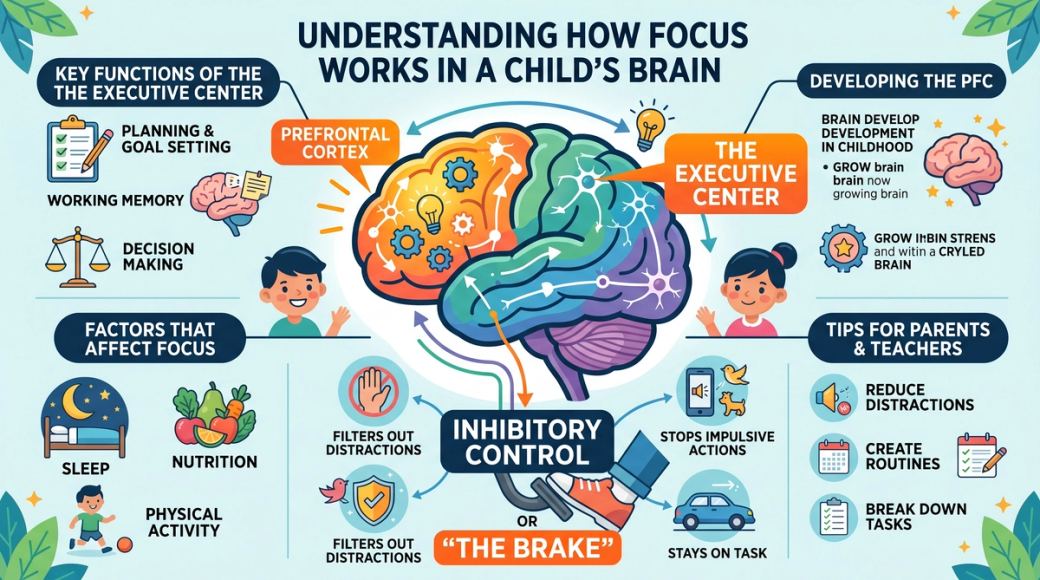
Focus isn't one skill — it's three working together.
- The first is working memory: the ability to hold the task in mind ("I'm doing the second math problem") long enough to finish it.
- The second is inhibitory control: not following every interesting input — the bird outside the window, the sibling walking past, the thought that's two thoughts away from the task.
- The third is cognitive flexibility: switching when needed without falling apart when the plan changes.
Together, these three live under the umbrella of executive function. They sit in the prefrontal regions of the brain — the part that's still wiring up all the way through childhood and into the early twenties. That's not a flaw; that's the timeline.
A review in Developmental Cognitive Neuroscience compared the evidence behind different ways of building executive function in children. The conclusion was direct: approaches grounded in movement, play, and practice in daily life have the strongest support. Computerised "brain training" alone — the kind that promises focus through a screen — has much narrower effects.
What this means for you: building focus isn't about adding pressure. It's about adding the right kind of reps at the right age.
Can a child focus without medication?
This question comes up often enough that it deserves an honest answer, not a sidestep.
Yes — for many children, daily input meaningfully builds the capacity that focus needs. Short movement-based practice, predictable routines, age-appropriate drills, sleep, and food the brain can actually run on. Many parents notice changes in weeks of consistent practice.
For some children, daily input is the full answer. For others, it's one layer alongside other support a paediatrician or specialist might recommend.
We don't take a position on medication — that's a conversation between a family and the clinicians who know the child. We do take a position on daily practice: it's the layer that's most often missing.
The next question is what to practise, and at what age.

How to improve focus in children — daily practices by age
What works for a 4-year-old and what works for a 9-year-old are not the same practice in different sizes — they're different practices. How to improve kids focus is age-shaped, and trying to apply older-kid tools to a younger brain backfires.
How to help your 3–6-year old focus
The window of focus at this age is measured in minutes, not stretches. The brake is in early construction; sustained, sit-still focus isn't a developmental fit yet — and asking for it tends to make the next minute harder, not easier.
The practice that works at 3–6 is the two-minute focus game. Pick something small and physical: a finger-touch sequence, an animal walk across the room to a chair, balance-on-one-foot while saying the next thing they remember about a favourite story. A few minutes. Once a day. The point is to name what focus feels like inside the body, so the brain can find it again on its own.
One soft rule: do it with them. Co-doing is the regulation at this age. The practice is half about the brain, half about the nervous-system match next to them.
How to help your 7–9+ year old focus
The window is longer now, but still partial. The brake is wiring faster, and you'll see real focus appear in pockets — but inhibitory control under load (loud room, hard task, low sleep) is still the first thing to drop.
The practice that works at 7–9+ is the 5-minute name-and-do drill. The child names out loud what they're about to focus on ("I'm going to do the first three math problems"), starts a five-minute window, and at the end names what they noticed about their own focus ("I got pulled away when my brother came in").
Pre-naming recruits the prefrontal regions before the task starts. Post-naming builds the metacognitive layer — the ability to watch their own attention, which is what older-kid focus is actually made of.
This age can hold a brief drill. They can't hold pressure. Frame the practice as let's notice, not let's measure. The noticing is the practice.

Executive function exercises kids can do at home
Executive function isn't trained at a desk. It's trained in the body, in short repetitions, across the kinds of moments that already happen at home. The Harvard Center on the Developing Child describes executive function as a set of skills built through repeated, everyday interactions — exactly the kind of input these exercises provide.
These are short. Most of them take a few minutes. You can do them between breakfast and the school run.
- Cross-crawls — inhibitory control + bilateral processing. Opposite hand touches opposite knee, slow, eyes tracking the moving hand. Engages both brain hemispheres at once — the same circuitry that holds the brake online when the room gets loud.
- Lazy 8s — focus + visual tracking. Trace a horizontal figure-8 in the air with a finger; eyes follow. Visual mid-line crossing loads attention while keeping the body calm — useful right before homework.
- The "stop and name" game — working memory + cognitive flexibility. During free play, you call "stop"; the kid names what they were just doing, then chooses whether to keep going or switch. Builds the gap between impulse and action.
- Belly breathing in pairs — the regulation layer. Six slow breaths together — your child's hand on your belly, yours on theirs. Widens the window of tolerance that focus has to sit inside.
For a deeper library of short, body-based attention span activities for kids, our brain-breaks guide groups them by goal — focus reset, energy release, calm-down — with how-to for each.


Want a focus plan built around your child?
When daily practice isn't enough
A daily practice builds capacity. It doesn't replace specialist care.
If you're seeing persistent severe focus difficulty alongside sleep disruption, mood changes, or struggles that don't ease after weeks of consistent practice, that's a different conversation — your paediatrician might be the right next step.
This isn't a question of whether something is wrong. It's a question of which support fits.
Frequently asked questions
Why can't my child focus?
How can I help my child focus at home?
At what age should I be concerned about my child's focus?
Where focus actually comes from
A smart child who can't focus isn't lazy and isn't careless. The brake hasn't finished wiring — and the most useful thing you can do is give it the right reps, at the right age, every day.
Short. Body-based. Done together. Two minutes turns into five, five turns into the homework hour that doesn't end in tears. The work that makes focus available later is the work you do now, in small moments, before the moment when focus is needed.
Improving kids' focus isn't a stricter timer or a louder reminder. It's a daily layer that builds what the brain is still learning to hold.
Related articles

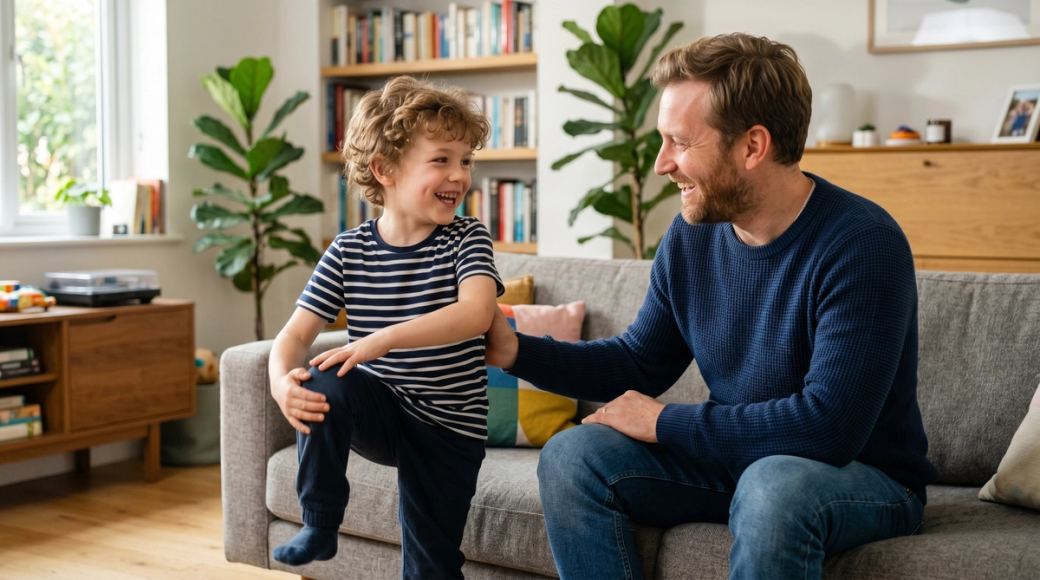
Movement Breaks: Get Kids Moving to Reset Focus
Movement breaks reset a child's focus by working the body first. Here's the science, when to use them, and movement break ideas for class or home.

Easy Brain Breaks for the Classroom
Brain breaks for the classroom: an evidence-informed teacher's guide to quick movement resets that refocus a class — by grade, energy level, and transition.
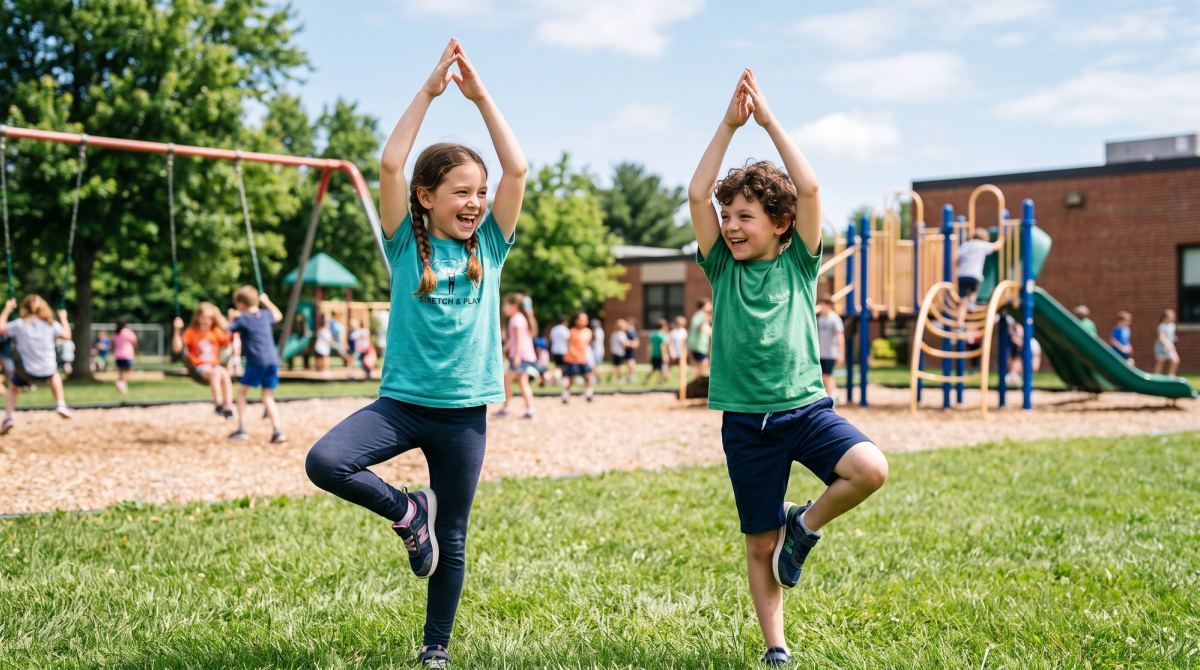
Brain Breaks for Students: Elementary & Middle School
Brain breaks for elementary and middle school students — age-appropriate movement resets that refocus a class or a tween at home, without the kiddie feel.

Brain Breaks for Kindergarten and Preschool (Ages 3–6)
Brain breaks for kindergarten and preschool: short, playful movement pauses for ages 3–6 that reset wiggly focus at circle time or at home.