
How to Help Your Child with Emotional Meltdowns


You're in the cereal aisle and your five-year-old has melted down because the box they wanted is gone. You're at a cousin's birthday party, and the moment the cake comes out, your child is on the floor sobbing. It's homework time, and a quiet "no" has turned into forty minutes of tears.
If any of that sounds familiar, your child isn't being difficult. Their brain has run out of capacity, and the only signal it has left is the wave you're watching.
Meltdowns aren't bad behaviour. They're what happens when a child's nervous system tips past what it can handle — and the regulating part of the brain temporarily goes offline. How to help a child with emotional meltdowns is partly the moment, partly the daily reps that make the next one rarer.
This guide covers the difference between meltdowns and tantrums, how to ease one in the moment, and what to build over time.
Key takeaways
- A meltdown is involuntary — the moment a child stops being able to hold it together. A tantrum is goal-directed behaviour. They look similar; they need different responses.
- In the moment, the goal isn't to fix the feeling — it's to help the brain come back online.
- Co-regulation comes first: a child's nervous system borrows the calm of a regulated adult.
- Daily emotional regulation activities for kids (breath, naming, predictable transitions) build the capacity that prevents the next flood.
What is an emotional meltdown?
A meltdown is what happens when a child's brain has been pushed past its capacity to handle input — too much noise, too many demands, too much tiredness, too much disappointment, in any combination.
When the upstairs brain (the regulating, planning, decision-making circuitry) loses traction, the downstairs brain (the emotion centres) runs the show. From the outside, it looks like rage or grief or freeze. From the inside, to the child, it feels like a wave they can't get out of.
This is different from a bad mood or being "difficult." A child in a meltdown isn't choosing the wave. They're inside it.
The first thing to know, before anything else, is what kind of moment you're actually in — a meltdown, or a tantrum.

Meltdowns vs tantrums: how to tell the difference
A meltdown and a tantrum can look identical from across the room — same crying, same chaos, same body on the floor. They aren't the same thing.
- A meltdown is involuntary. The nervous system has been overwhelmed. The regulating brain is temporarily offline; the child is reacting, not communicating. Trying to negotiate — "if you calm down, you can have…" — deepens it, because no negotiation is happening on the child's side.
- A tantrum is goal-directed. The child is communicating a want — a cookie, an extra ten minutes, a battle with a sibling. The brain is online; the behaviour is a tool. Co-regulating a tantrum the way you'd co-regulate a meltdown can reinforce it.
Parents often search for how to stop child tantrums. For a true tantrum, the most workable approach is to hold the limit calmly, name the want, and not negotiate against it. The verb is "hold," not "stop." Stopping the behaviour is the wrong target; holding the frame is the right one.
Quick check — meltdown or tantrum?
It's likely a meltdown if:
- The child isn't asking for anything
- Talking to them doesn't reach them — words seem to bounce off
- It started after a build-up (busy day, missed nap, sensory load)
- You feel helpless watching it happen
It's likely a tantrum if:
- There's a specific want underneath ("I want the iPad")
- The child checks to see whether you're watching
- It stops when the want is met — or moves on when you hold the limit
- You feel pulled into negotiation
Knowing which one you're in is the first step in how to help your child with emotional meltdowns — the in-the-moment response depends on it.

Why does my child overreact to everything?
It's rarely about overreaction. It's that the child's window of tolerance (the range of input the nervous system can handle before it tips into survival mode) is narrower than an adult's. After a busy day, a missed nap, sensory overload, or three small disappointments in a row, that window narrows further.
Sensing the world comes in early; regulating the response to it takes longer. When you see a child overreact to everything, you're frequently watching the gap between what they can perceive and what they can yet regulate.
The reaction isn't out of proportion to them — it's out of proportion to what we, as adults, can tolerate.
Daily reps shape that gap. Not by suppressing reactions, but by widening the window over time.
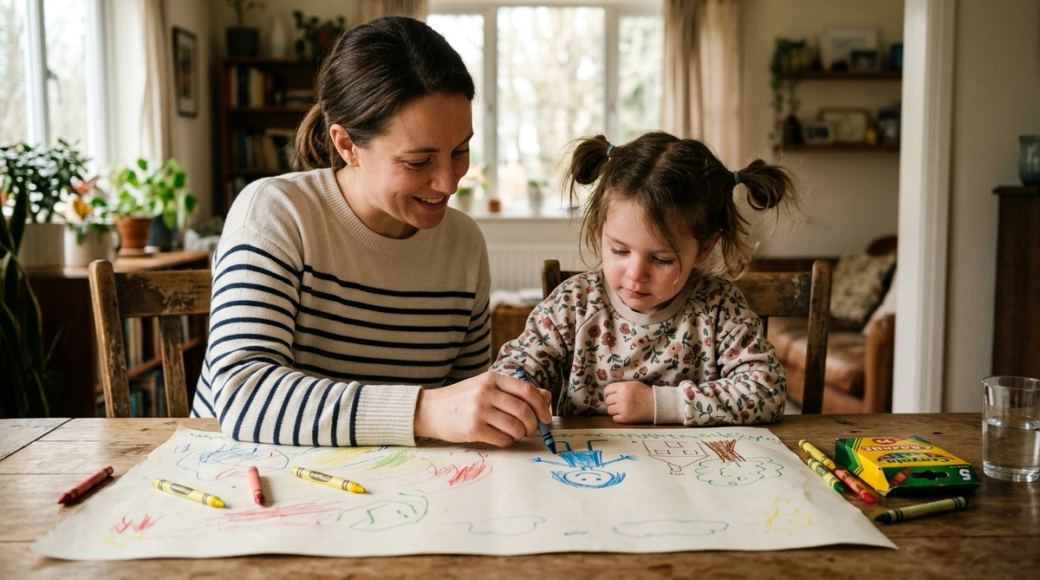
How to calm a child having a meltdown in the moment
When a meltdown is happening, the goal isn't to fix the feeling. It's to help the brain come back online. The fastest route is through your own nervous system — yours has to settle before theirs can borrow the regulation.
1. Slow your own breath first. Long exhales — out longer than in — downshift your nervous system before you do anything else. A recent review in Trends in Neuroscience and Education describes how parent-child interactions shape the neural circuitry that handles emotion — the prefrontal regions that come online during a child's hardest moments are built through repeated co-regulation with a regulated adult. Your breath is the first co-regulation tool. Aim for six slow breaths before you speak.
2. Then co-regulate through your body. Soften your face. Drop your voice register. Get down to their eye level without saying anything yet. A child's nervous system borrows what yours is doing — face, shoulders, breath rate — long before it can borrow your words.
3. Reduce input. Noise, lights, screens, demands, eyes-on-them — all are extra signals a flooded brain can't process. Dim the room or step outside. This is where how to help a child self regulate in the moment really starts: by lowering the load on a system already overwhelmed, not by adding skills mid-flood.
4. Name it to tame it — later. When the wave starts to break, naming the feeling out loud ("that was a really big feeling") recruits the language part of the brain, which helps the regulating circuits come back. Save it for the come-down. Naming mid-flood can deepen the wave.

Emotional regulation activities for kids you can build into the day
The longer-term piece of how to help a child with emotional meltdowns happens between meltdowns — not in them. A few small emotional regulation activities for kids, repeated, widen the window of tolerance over time. None of these is a meltdown tool. They're the input that makes meltdowns rarer and shorter when they do happen.
- Paired belly breathing. Six slow breaths together — child's hand on your belly, yours on theirs. Builds the breath-as-regulation reflex outside the crisis moment, so it's available inside one.
- Nightly "name it." Each night, one feeling from the day named together: "What was the biggest feeling you had today?" Wires the brain to label before it floods.
- Predictable transitions. Most meltdowns sit at transition points. A two-minute warning before the iPad closes, a short ritual between school and home — these aren't optional; they're nervous-system infrastructure.
- Calm-corner setup. A quiet spot the child chooses, with soft texture and dim light, available before they need it. Not a punishment chair — a regulation tool. This is also where how to help a child self regulate moves from the in-the-moment to the long-term — by giving them somewhere their body learns to settle on its own.
Beyond breath and naming, short movement-based practices widen the window of tolerance most directly. The Harvard Center on the Developing Child describes executive function as a skill built through repeated, everyday interactions.

Want a daily sequence built around your child?
Frequently asked questions
What's the difference between a meltdown and a tantrum?
How do you calm a child having a meltdown?
Are there activities that help with emotional regulation?
Behind the wave
The meltdown isn't your child being difficult. How to help a child with emotional meltdowns isn't about preventing every wave — that's not the work. The work is your own regulation, plus a few small daily inputs that widen what your child's brain can carry over time.
Do one practice from the weekly list. Add another when the first feels habitual. The next meltdown will still come. It will be shorter. The one after that, shorter still.
Related articles

Movement Breaks: Get Kids Moving to Reset Focus
Movement breaks reset a child's focus by working the body first. Here's the science, when to use them, and movement break ideas for class or home.

Easy Brain Breaks for the Classroom
Brain breaks for the classroom: an evidence-informed teacher's guide to quick movement resets that refocus a class — by grade, energy level, and transition.

Brain Breaks for Students: Elementary & Middle School
Brain breaks for elementary and middle school students — age-appropriate movement resets that refocus a class or a tween at home, without the kiddie feel.

Brain Breaks for Kindergarten and Preschool (Ages 3–6)
Brain breaks for kindergarten and preschool: short, playful movement pauses for ages 3–6 that reset wiggly focus at circle time or at home.