
How to Calm a Hyperactive or Impulsive Child


You're at the playground, and you can see the spike coming before it lands — the running gets faster, the voice gets louder, and you can't quite get there in time. You're at the dinner table, and the same kid is up and down five times in three minutes, knocking the cup, missing the chair, half a step ahead of every sentence. You're standing in the kitchen ten seconds after a hit, and both of you are wrecked — your child more than you, and you more than you'd like to admit.
If any of that sounds familiar, the most useful first thing to know is this: hyperactivity and impulsivity aren't behaviour problems. They're a nervous system running ahead of the brake.
How to calm a hyperactive child is partly a question about what's happening in the body in that moment, and partly a question about what daily input actually moves the dial. This guide gives you something you can start this week without a sticker chart, a louder voice, or a time-out chair.
Key takeaways
- Hyperactivity and impulsivity are nervous-system patterns, not behaviour problems — so the most useful response lands at the body level, not the consequence level.
- Time-outs and reward charts often miss the mechanism: a child whose brake is offline can't think about what they just did until the body is back online.
- In the moment, co-regulation comes first — the parent's calm regulates the child's nervous system before any words can.
- Daily body-based practice — short, predictable, age-appropriate movement and breath drills — builds the brake over time.

Why the body has to come back online first
For a child mid-spike — hyperactive, impulsive, or both — the part of the brain that does the reflecting is exactly what's gone offline.
The prefrontal regions hold the brake, name what just happened, and choose differently next time. When the nervous system is flooded, those regions temporarily lose traction. The downstairs brain runs the show.
A study in Biological Psychology followed children from preschool to adolescence and found that emotion dysregulation tracks closely with how well a child's vagal system modulates the body under load — the same autonomic system that calms a flooded child through breath, rhythm, and proprioceptive input.
The thinking comes later. The body has to come back online first — and what brings it back is body-based input. Time-outs and reward charts, designed for a child whose brake is already online, often miss the moment a hyperactive or impulsive child most needs help.

Why your child shows impulsive behaviour (and big-energy patterns)
Parents who search “impulsive behavior in children” are usually watching the same thing — the gap between thinks of something and does it collapses to almost nothing.
That gap is held by the part of the brain (the prefrontal inhibitory-control circuitry) that pauses the impulse long enough for a different choice to show up. It's the last region of the brain to finish wiring through childhood — and the first one to drop offline when the system is overloaded.
When the brake is still building, the body acts on the input it gets. And a big-energy child gets a lot of input.
Under load — too much noise, too many demands, low sleep, big emotions, sensory spikes — even the partial brake a child has built drops further. What looks like won't sit still or always pushing, or can't stop interrupting, is often a body in survival mode: move, escape, escalate. The body is running ahead of the brain, because the brain hasn't finished wiring the part that can keep up.
Some kids also run a higher sensory load by default. The playground is louder, the classroom busier, the dinner table more stimulating. Sensory input and a still-wiring brake can compound, and what looks like wilful behaviour is often a body trying to discharge more than it can hold.
How do I stop my child from hitting?
If you're searching this, you're not failing. You're watching a nervous system overflow in real time and trying to find the lever that works.
Hitting in a hyperactive or impulsive moment is rarely strategic. It's an overflow. The body acted before the brake came online — and “stop” as a command lands on the part of the brain that's currently offline.
What helps is the opposite of distance. Come close instead of moving further away. Use a few words. Name the boundary once and hold it without escalating — “we don't hit; I'm here; breathe with me”. The boundary stays clear; the lever isn't pressure, it's the body next to theirs. Repair after (when the body is back online) by naming what happened and what comes next.
The daily layer is what reduces the next overflow. That's the next part.

How to calm a hyperactive child in the moment
The first thirty seconds belong to the parent's nervous system, not the child's. A child's system borrows the calm of the regulated adult next to them — co-regulation is the lever that works before any words can.
Four things, in this order.
- Slow your own breath first. Three slower exhales than inhales. Your child's system is reading yours before they hear what you say.
- Body proximity over words. Come close, lower yourself to their height, hands available. The body says “safe” faster than language can — and the words won't land until the body has.
- Sensorimotor input. Slow rhythmic movement (rocking, walking together), heavy pressure (a firm hug, a weighted blanket, a hand on the back), or a big squeeze if they're already moving toward you. These are vagal-tone inputs — they tell the brake to come back online by routing through the body, not through the words.
- Repair after, not during. Name what happened, name what comes next, name what you noticed about your own body — but only after the body has come back online. Anything earlier than that lands on a brain that isn't yet available to take it in.
If the spike sits inside a tantrum or meltdown rather than a pure impulse moment, our meltdown guide goes through the in-the-moment script for that shape of overflow.
This is the moment. The daily layer is what makes fewer of these moments.
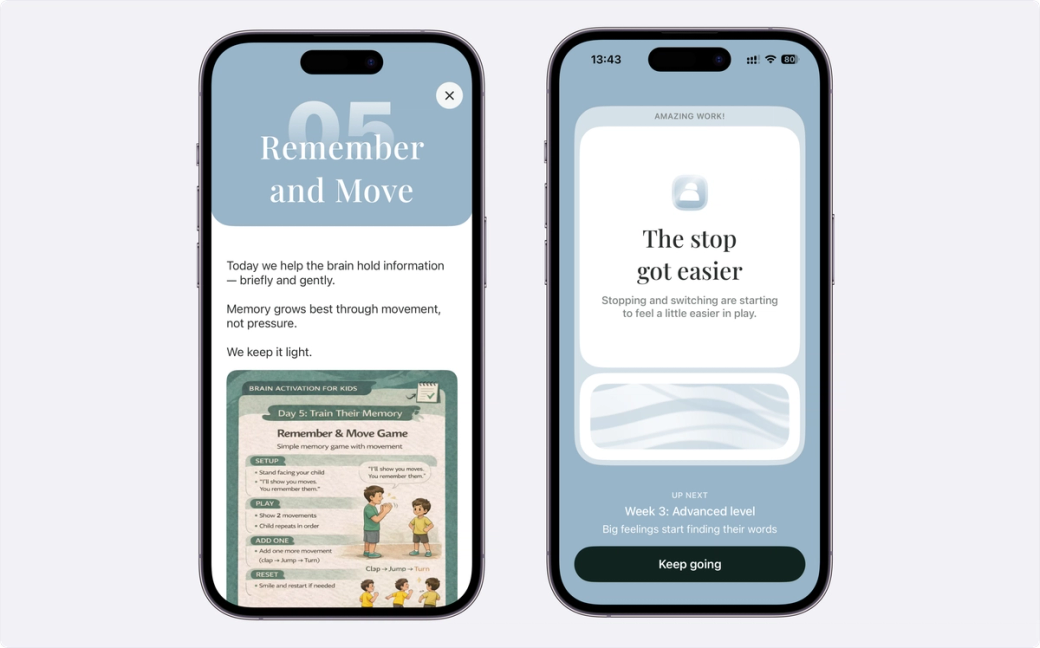
Daily nervous-system regulation: what to build at home
Hyperactivity and impulsivity ease over time, the way every other developmental skill does — through short, predictable, body-based reps. Together, over weeks, they build the regulating capacity a child draws on in the harder moments.
The Harvard Center on the Developing Child describes self-regulation as a set of skills built through repeated, everyday interactions — exactly the kind of input these practices fit into.
- Cross-crawls — bilateral integration and inhibitory control. Opposite hand touches opposite knee, slow, eyes tracking the moving hand. Engages both hemispheres of the brain at once — the same circuitry that holds the brake online when the room gets loud. Younger kids: thirty seconds; older kids: a minute or two.
- Animal walks — proprioceptive input. Bear crawl across the room, crab walk back, frog jump in place for sixty seconds. Heavy-work movement gives the nervous system the regulating input it's been seeking, often through faster movement that's harder to slow down.
- Slow-rhythm breathing in pairs — vagal-tone calming. Six slow paired breaths together, with your child's hand on your belly and yours on theirs. Widens the window of tolerance the brake has to sit inside. Best done outside the spike, so the body learns the pattern before it's needed.
- The stop-and-name game — impulse-control practice. During free play, you call “stop”; your child names what they were just doing, then chooses whether to keep going or switch. Builds the gap between impulse and action.
For more short body-based practices like these, our brain-breaks guide groups them by goal — focus reset, energy release, calm-down.


Want a calm-down plan built around your child?
Frequently asked questions
Is my child hyperactive, or just energetic?
Why does my child overreact to everything?
Are time-outs ever okay?
Where the calm actually comes from
A hyperactive or impulsive child isn't out of control and isn't bad. The most useful thing you can do is build that regulation in calm, everyday moments, so the body already has it when the next spike arrives.
Co-regulation in the spike. Short, body-based reps in the calm. The boundary held without becoming the lever. None of it is dramatic, but all of it compounds.
How to calm a hyperactive child isn't a louder voice or a stricter chair. It's a daily layer that builds what the brain is still learning to hold.

Related articles

Movement Breaks: Get Kids Moving to Reset Focus
Movement breaks reset a child's focus by working the body first. Here's the science, when to use them, and movement break ideas for class or home.

Easy Brain Breaks for the Classroom
Brain breaks for the classroom: an evidence-informed teacher's guide to quick movement resets that refocus a class — by grade, energy level, and transition.

Brain Breaks for Students: Elementary & Middle School
Brain breaks for elementary and middle school students — age-appropriate movement resets that refocus a class or a tween at home, without the kiddie feel.

Brain Breaks for Kindergarten and Preschool (Ages 3–6)
Brain breaks for kindergarten and preschool: short, playful movement pauses for ages 3–6 that reset wiggly focus at circle time or at home.