
Feelings Thermometer
Feelings Thermometer for Kids
Set how big the feeling is right now, see what that can feel like in the body, and get two or three things that might help.
Which scale?
Which feeling? (optional)
Pick a level to see what might help.
Use your own words
Change any level's name to the words your child already uses.
Saved on this device only.
Save it
Nothing you type here leaves your device. We don't save it and we can't see it.
This tool is for everyday emotional learning. It is not medical advice, a diagnosis, or a screening test. If you're worried about your child, talk to your pediatrician or a licensed professional.
Naming the feeling is the first step. The next one is a daily habit.
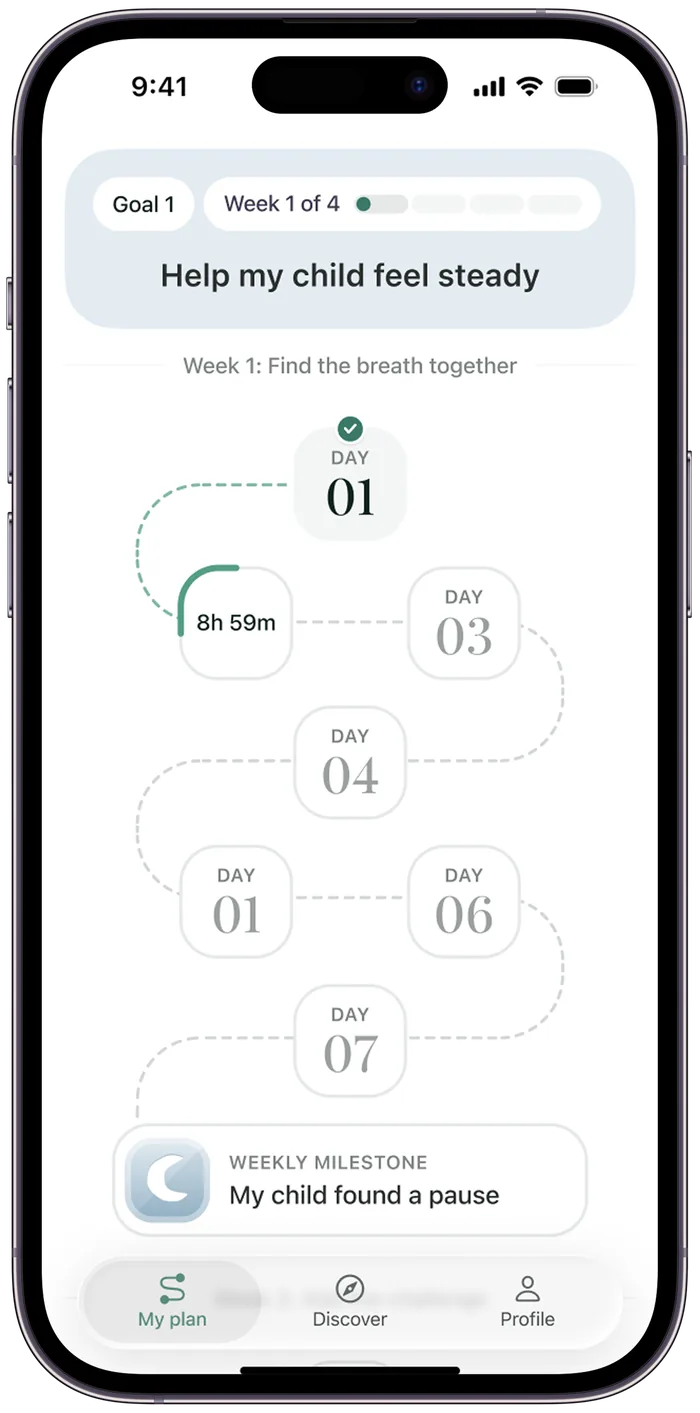
Leaply turns moments like this into a 5-10 minute daily routine of calming and brain activation exercises, matched to your child's age.
What is a feelings thermometer?
A feelings thermometer is a simple vertical scale a child uses to show how big a feeling is right now. It works the way a real thermometer does: calm sits at the bottom, and the top is as much as the feeling gets. You will also see it called an emotion thermometer or a feelings scale.
Most children find a picture easier than a sentence. Asking “where are you on the thermometer?” gives a four-year-old a way to answer long before they have words like frustrated or overwhelmed. It also gives you something specific to talk about together, instead of guessing from the outside.
How to use the feelings thermometer
Set the level, read what it can feel like in the body, then pick one thing to try. The whole thing takes under a minute. It works best when you practise it on an ordinary day — a scale you already know is far easier to reach for when things get loud. If the level is high and you want something to do rather than something to say, the brain break generator gives one idea sized to the minutes you have.
- Pick the scale that fits your child. The 5-level version suits ages 4 to 7. The 1 to 10 version gives older children room to say “a bit worse than yesterday”.
- Ask how big the feeling is right now — not what it is called, not why. Let them tap or drag to the level themselves.
- Read what that level can feel like in the body, together. Hot face, fast heart, busy legs. Naming the body is easier than naming the feeling, and it usually comes first.
- Try one of the suggested things. One is enough. If it does not land, move to the next one rather than talking about why it did not work.
Where the idea comes from
The idea traces back to the Subjective Units of Distress Scale — usually shortened to SUDS — which the psychiatrist Joseph Wolpe introduced in 1969 in The Practice of Behavior Therapy. It was a 0 to 100 scale adults used to rate how strong a feeling was at a given moment, so that change could be tracked over time instead of guessed at.
What carried over into classrooms and kitchens is the shape, not the numbers: one scale, one moment, rated by the person having the feeling rather than by someone watching them. This tool keeps that and drops the rest. The range is short, the words are plain, and nothing is scored, saved or sent anywhere.
Big feelings get easier when the day is set up for them.
Leaply turns what your child just noticed into a habit: a few minutes a day, built around their age and what they need.
Feelings thermometer FAQ
What is a feelings thermometer?
A vertical scale a child uses to show how strong a feeling is right now, from calm at the bottom to as big as it gets at the top. It is also called an emotion thermometer. It is not there to measure anything precisely — it is there to give a child a way to tell you where they are before they have the words for it.
What are feelings thermometer questions?
Short ones, in this order: where are you on the thermometer right now? What does your body feel like there? What would help? It is worth avoiding “why” — it asks a child to explain something they are still in the middle of, and most will go quiet rather than answer.
How do you use a feelings thermometer?
Pick the scale that fits your child’s age, ask how big the feeling is right now, read what that level can feel like in the body, then try one of the suggested things together. It takes under a minute. Practising it on a calm day is what makes it usable on a hard one.
How do I help my child identify their emotions?
Start with the body rather than the label. “Your hands are in fists” is easier to agree with than “you are angry”. Name feelings out loud in ordinary moments, including your own, and let your child borrow the words. A scale helps because it lets them answer with a number while the vocabulary is still catching up.
At what age can a child use a feelings thermometer?
From around four, using the 5-level version with a grown-up alongside. From about eight, most children can use the 1 to 10 version on their own. Below four a scale is usually too abstract, and simply naming feelings out loud as they happen does more.
How is this different from the Zones of Regulation?
Zones of Regulation is a full program that schools teach over many lessons, sorting feelings into four colour-coded zones and coming with its own set of materials. This is one scale that takes a minute, and it is not connected to that program. The colours here run along a single line from calm to too big rather than grouping feelings. If your child’s school uses Zones, the thermometer can sit alongside it as a quick check-in.